
.png)
.png)
.png)
.png)
_2026122-125305.png)
_2026122-125305.png)

_2026122-125305.png)
_2026122-125305.png)
_2026122-125305.png)










Sodium bicarbonate has been widely studied in sports nutrition, particularly in relation to high-intensity exercise. In this article, Nigel Mitchell explains the science behind “bicarb”, how it interacts with the body’s buffering systems, and the practical considerations athletes should understand when exploring its use.
Jump to:
What are nutritional Supplements?
It is important to understand what we mean by nutritional supplements. I class supplements into two groups, sports foods and ergogenic aids. The foods refer to nutrients that we can get from foods but taking it in the form of supplement can be more convenient and controllable; these can include protein, omega 3 oils and carbohydrates. The ergogenic aids refer to products which if taken in sufficient quantities can improve performance. Ergogenic aids include nutrients such as creatine and sodium bicarbonate (bicarb).
Science Corner
Sodium bicarbonate (NaHCO₃) is a white powdered salt. It is crucial for the body to maintain a stable pH. pH (percentage hydrogen) refers to the acidity-alkalinity and is presented on a scale of 1-14. A pH of 7 is neutral (water has a pH of 7), lemon juice has a pH of between 2-3 because it contains citric acid and green leafy vegetables tend to be more alkalising.
The body works hard to maintain a close pH range in the blood of about 7.35-7.45 and the muscle, 6.8-7.2. During intense exercise, muscle pH drops slightly, this is because during anaerobic metabolism (lack of oxygen), lactate is formed which allows some continued energy production. As the lactate is formed, acid (hydrogen ions) is produced, lowering the pH.
This reduced pH slows down the carbohydrate metabolism and reduces the flow of energy, consequently reducing performance. The muscle cell has some natural ‘buffers’ (neutralise the acid) such as carnosine. Carnosine is formed by the amino acids, beta alanine and histidine. The limiting amino acid is beta alanine, which has now become a popular ergogenic aid. I started using beta alanine with Olympic cyclists around 20 years ago.
The carnosine helps to buffer some of the acid in the cell, however the body has developed multiple buffers to cope with the increase in acid.
The bicarb neutralises the acid as it migrates out of the cell. Increasing the plasma concentration of bicarb results in an increased capability to neutralise more acid and therefore allowing intense exercise to continue.
In order for athletes to maximise their buffering strategy, they will use both beta alanine and sodium bicarbonate supplementation. This is known as ‘stacking’. I first used this strategy with the GB Team Pursuit squad in preparation for the Beijing Olympic Games. Beta alanine needs to be loaded over a period of time and sodium bicarbonate is taken more as an acute dosage.
- Blood pH is maintained at about 7.35-7.45.
- Muscle pH typically ranges from 6.8-7.2.
- During intense exercise, acid (hydrogen ions) is produced, lowering pH.
- The bicarb neutralises the acid as it migrates out of the cell.
How and when to use bicarb?
Sodium bicarbonate is widely used by athletes, I have used it in wide range of sports, including Olympic triathlon, cycling, athletics and cross-country skiing. It can be used as both a training aid and in competition. It is commonly used in team sports such as rugby and football. I have found it particularly effective during specific time trial training sessions with cyclists and middle-distance track runners.
There are various presentations of sodium bicarbonate, the most basic is using simple ‘baking soda’ which can be found in the home baking aisle of the supermarket. If using baking soda, it has to be carefully weighed out and it is easy to make an error. In my experience, this is the one associated with the worst side effects which is gastrointestinal distress, such as bloating, flatulence and diarrhoea. Another drawback of using bicarbonate powder is the taste, which is like sea water.
The most effective dosage of sodium bicarbonate is 0.3g/kg. A 70kg athlete would need 21g of bicarbonate.
Healthspan Elite have managed to overcome the taste issue of bicarb by encapsulating the powder in time release capsule. This means that the capsule bypasses the stomach (which is acidic and neutralise some of the bicarb) and is released in the small intestine where it is absorbed in the jejunum and ileum.
Each Healthspan Elite capsule delivers 1g of sodium bicarbonate (a lot of the commercially available bicarb capsules contain 0.8g of bicarb which can make the dosing calculations more complicated.
Feedback I have had from athletes is when they take bicarb from capsules there are less negative side effects of stomach issues. This is backed up by research, for more information please follow the links below.
The guidance on sodium bicarbonate usage is 300mg per 1kg of body weight. 3x tablets (3g sodium bicarbonate) to be taken for every 10kg of body weight. E.g. a 70kg track athlete would take 21 sodium bicarb tablets. A 120kg rugby player would take 36 sodium bicarb tablets. To help reduce the risk of the stomach issues I recommend taking at least 500ml of fluid and carbohydrate.
After ingestion it takes about 90 minutes to reach peak plasma levels. If an athlete is competing at 12 noon then they should take the bicarb at 10.30. The plasma remains elevated for about 3 hours. This is plenty of time for most events, however if an athlete is competing in multiple heats over the full day the athlete can top up by taking half a dose top up. E.g. A 70kg athlete competing round 1 at 12 noon, semi final 2pm and final at 5pm could take 21 capsules at 10.30 and another 10 capsules at 3.30pm.
- 0.3g/kg — The most effective dosage of sodium bicarbonate.
- 300mg per 1kg — Guidance on sodium bicarbonate usage.
- 3g per 10kg — “3x tablets (3g sodium bicarbonate)” per 10kg of body weight.
- 500ml — Minimum fluid recommendation (with carbohydrate) to help reduce stomach issues.
- 90 minutes — Time to reach peak plasma levels after ingestion.
- 3 hours — How long plasma remains elevated after ingestion.
Quality Assurance
When anyone is considering using any supplement I always suggest that they consider the quality assurance of the product, The Healthspan Elite sodium bicarbonate capsules, like all of the Healthspan Elite range, are tested and registered on the Informed Sport Program (https://sport.wetestyoutrust.com).
Further reading
If you have found this article interesting and you want to dig a little bit deeper into the science please check out the links below.
- Effect of sodium bicarbonate contribution on energy metabolism during exercise: a systematic review and meta-analysis
- Sodium bicarbonate ingestion and repeated swim sprint performance
- Mechanistic insights into the efficacy of sodium bicarbonate supplementation to improve athletic performance
- Effects of sodium bicarbonate supplementation on exercise performance: an umbrella review
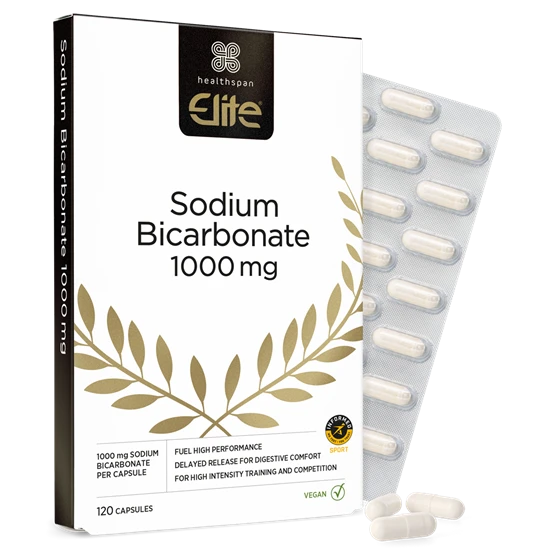
Sodium Bicarbonate
For high-intensity training & competition
- 1000 mg sodium bicarbonate per capsule
- Delayed-release for digestive comfort
- Supports short, explosive bursts of exercise